
Consumer Abuse
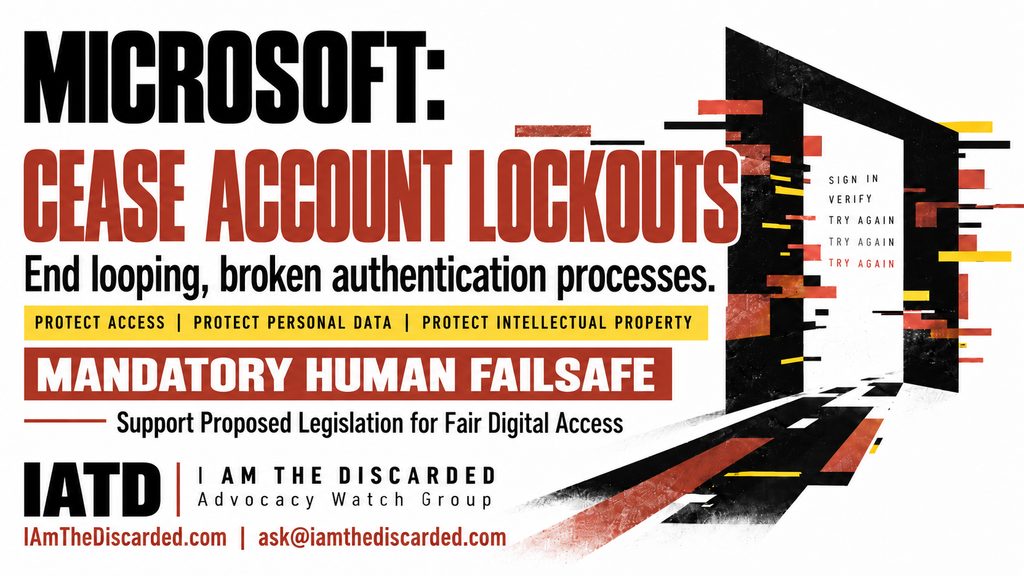
When Broken Authentication Becomes a Consumer-Protection Issue
Account security is necessary. But when a security system repeatedly prevents a legitimate customer from accessing an account, completing identity verification, making a payment, or reaching important stored information, the security process itself becomes part of the problem.
Consumers increasingly rely upon cloud-based services for far more than casual email or convenience. Digital accounts may contain legal documents, educational materials, research, financial records, professional correspondence, personal information, photographs, intellectual property, and other data that may be difficult—or impossible—to recreate.
And there is another critical fact that should not be lost in the discussion:
Many of the people affected are paying customers.
Consumers pay monthly or annual subscription fees for Microsoft 365, cloud storage, email, productivity software, and related services with the reasonable expectation that those services will remain usable and that their data will remain reasonably accessible.
A paying customer should not be trapped in a malfunctioning authentication loop, denied meaningful human assistance, and then left unable to reach files, records, or work product that the customer is paying Microsoft to store, maintain, and make accessible.
When access to that information is interrupted because of looping authentication, repeated CAPTCHA failures, password-recovery dead ends, or automated account restrictions, the consequences can extend well beyond frustration.
This becomes a consumer-protection, data-access, and continuity-of-service issue.
THE PROBLEM: LOOPING, BROKEN AUTHENTICATION PROCESSES
A troubling pattern has emerged in consumer complaints involving authentication systems that repeatedly require users to prove their identities but fail to provide a successful path to completion.
A legitimate user may be instructed to:
verify an identity;
reset a password;
complete a CAPTCHA;
respond to another verification challenge;
and then repeat the process again.
Instead of restoring access, the system may return the user to another “Try Again,” “Verify,” or “We Couldn’t Verify You” screen.
The customer is attempting to comply.
The customer is attempting to establish identity.
In some cases, the customer may also be actively attempting to pay for or renew the service.
Yet the automated authentication process itself becomes the obstacle.
Consumers have publicly reported problems involving Microsoft’s “Press and Hold” CAPTCHA and other verification processes that repeatedly fail or send users back through the same authentication sequence.
That distinction matters.
A consumer who refuses to verify identity presents one situation.
A consumer who repeatedly attempts to comply but cannot complete the process because the verification mechanism continually loops, fails, or rejects the legitimate customer presents an entirely different consumer-protection concern.
SECURITY MUST WORK IN BOTH DIRECTIONS
Technology companies have a legitimate responsibility to protect customers from fraud, hacking, identity theft, unauthorized account access, and other cybersecurity threats.
Strong security is essential.
But effective account security must perform two functions simultaneously:
Keep unauthorized users out.
Allow authorized users in.
A security system that repeatedly blocks the lawful customer without providing a meaningful alternative route to verification is not functioning effectively for that customer.
Cloud-service providers have encouraged consumers to entrust enormous amounts of important information to remotely stored systems.
That reliance creates a corresponding responsibility.
When automated authentication fails, there should be a reasonable pathway through which the legitimate account holder can establish identity and regain appropriate access.
MANDATORY HUMAN FAILSAFE
No major digital provider should operate an account-recovery system without an effective human failsafe.
When automated authentication repeatedly fails, consumers should have access to a trained representative or escalation team with sufficient authority to examine alternative proof of identity and determine whether access can safely be restored.
A genuine human failsafe should be capable of addressing circumstances in which:
CAPTCHA challenges continually fail;
password recovery repeatedly loops;
automated risk systems incorrectly flag legitimate users;
verification codes cannot be received;
recognized devices are rejected;
or account-recovery procedures repeatedly return consumers to the same failed process.
Directing a customer back into the very system that generated the problem is not meaningful escalation.
It is simply another loop.
PAYING FOR A SERVICE YOU CANNOT ACCESS
This issue becomes even more serious when consumers are continuing to pay—or are actively attempting to pay—for the very service from which they are being denied access.
A company should not be permitted to create this kind of contradiction:
Pay for the service—but the authentication system prevents you from completing payment.
Maintain your subscription—but you cannot reach the account necessary to manage it.
Store your information with us—but a failed automated process may prevent you from reaching it.
Contact support—but no meaningful human escalation is available to resolve the underlying access problem.
Consumers are not asking for free access to someone else’s system.
They are asking for reliable access to services they pay for and to data they lawfully placed there.
A company that accepts recurring subscription payments while controlling access to the customer’s files, email, applications, and cloud storage should have a corresponding obligation to maintain reasonable procedures for legitimate customers to regain access when automation fails.
THE CONSUMER-PROTECTION AND COLLECTION-PRACTICE ANALOGY
There is also a broader public-policy issue.
American consumer-protection law has long recognized that companies seeking payment should not be permitted to use abusive, deceptive, harassing, or unreasonably coercive practices.
This does not mean that Microsoft or another technology provider necessarily meets the legal definition of a “debt collector” under existing federal or state debt-collection laws.
The comparison concerns the underlying principle.
A company should not be able to gain unreasonable leverage over a consumer by controlling access to something critically important while simultaneously making resolution unnecessarily difficult.
In the digital economy, that leverage can be substantial.
A technology provider may control practical access to years of records and information.
If an account-access problem becomes connected to billing, subscription renewal, identity verification, or account recovery, a consumer may find himself or herself trapped between the need to resolve the account problem and the inability to reach the information necessary for everyday professional or personal responsibilities.
That is especially concerning when the customer is trying to pay.
A consumer should not be placed in a position where a company’s own verification system prevents payment and the company can then potentially treat the resulting failure to complete payment as a problem created by the consumer.
Whether or not existing debt-collection statutes apply, the potential coercive effect and imbalance of power warrant consumer-protection scrutiny.
ACCOUNT LOCKOUTS CAN CREATE SERIOUS REAL-WORLD CONSEQUENCES
Digital account lockouts do not occur in isolation from everyday responsibilities.
Consider a law office temporarily unable to retrieve documents necessary to prepare for a hearing, meet a filing deadline, communicate with a client, or review important case materials.
Consider a college or graduate student approaching a deadline for a thesis, dissertation, examination, research submission, scholarship application, or major academic project whose materials are stored or transmitted through a cloud-based account.
Consider an educator unable to reach course materials, research, student communications, or institutional records.
Consider an individual who suddenly cannot access financial records, tax documents, family records, photographs, or other important personal information.
These are not trivial inconveniences.
Legal filing dates continue to run.
Court appearances remain scheduled.
Academic deadlines remain in place.
Examinations do not automatically move.
Research submissions do not stop because an authentication program has entered another verification loop.
Technology providers should recognize that disruptions involving access to stored data can produce consequences far beyond the account itself.
THE TURNBULL CASE SHOWS HOW SERIOUS CLOUD LOCKOUTS CAN BECOME
One legal dispute demonstrates the potential seriousness of losing access to professional cloud-based information.
In Turnbull Legal Group, PLLC v. Microsoft Corp., a Houston criminal-defense law firm lost access to its Microsoft OneDrive account.
The account contained attorney work product associated with pending criminal cases.
The firm’s efforts to restore access ultimately escalated into emergency litigation.
A trial court determined that continued denial of access presented the possibility of immediate and irreparable harm and initially granted emergency relief. Microsoft was later required to place much of the firm’s data onto external hard drives so the material could be returned.
The circumstances of the Turnbull dispute were different from concerns involving looping authentication and CAPTCHA failures. The litigation involved Microsoft’s suspension of an account based upon alleged violations of its policies.
It therefore should not be characterized as a lawsuit about CAPTCHA authentication.
But the case demonstrates an important principle:
Loss of access to professionally significant cloud-stored information can produce immediate and substantial real-world harm.
Consumers should not have to reach a courthouse before a technology company provides a meaningful mechanism for protecting and retrieving their own information.
THE LAW NEEDS TO CATCH UP WITH THE TECHNOLOGY
The modern digital economy has developed faster than many of the consumer-protection laws governing it.
That gap should be addressed.
Proposed legislation should establish minimum protections for consumers whose information is stored within major digital-service platforms.
Those protections should include:
Mandatory Human Failsafe — when automated verification repeatedly fails, consumers must have access to meaningful human review.
Alternative Identity Verification — companies should maintain reasonable alternative methods for establishing account ownership.
Data Preservation During Disputes — customer data should not be deleted or destroyed while a documented authentication, billing, or access dispute remains unresolved.
Reasonable File-Export Rights — where legally permissible, consumers should have a mechanism for retrieving or exporting their own data even when other account functions are restricted.
Protection During Payment or Billing Problems — consumers who are actively attempting to pay or resolve an account balance should not face unnecessary suspension, deletion, or loss of stored information because authentication prevents completion of the transaction.
Clear Escalation Procedures — consumers should be told exactly where to go when ordinary automated recovery fails.
Accountability for Unreasonable Lockouts — providers should face meaningful consequences when improperly maintained access restrictions cause demonstrable harm.
SUPPORT PROPOSED DIGITAL-ACCESS LEGISLATION
The guiding principle should be straightforward:
PROTECT ACCESS.
PROTECT PERSONAL DATA.
PROTECT INTELLECTUAL PROPERTY.
REQUIRE A MANDATORY HUMAN FAILSAFE.
Consumers should not be forced to choose between cybersecurity and reasonable access to their own information.
We can have both.
And consumers who pay for digital services should have reasonable assurance that the company accepting those payments has built a functioning pathway for legitimate customers to access what they are paying for.
HAVE YOU EXPERIENCED THIS?
Readers who have experienced similar Microsoft account problems are encouraged to tell us what happened.
Have you encountered:
repeated CAPTCHA failures;
a “Press and Hold” challenge that would not complete;
continuous “Try Again” screens;
password-recovery loops;
repeated identity-verification demands;
an unexpected account restriction;
or an ultimate account lockout?
Were you paying for the Microsoft service at the time?
Were you attempting to renew or make a payment when the problem occurred?
Were you able to reach a human representative?
Were you provided an alternative method of proving your identity?
How long did the problem continue?
Did the lockout affect legal work, court deadlines, educational assignments, research, examinations, thesis or dissertation work, financial records, or other time-sensitive responsibilities?
And most importantly:
Was the problem ultimately resolved?
Individual experiences may appear isolated.
When similar complaints are documented together, they can reveal whether a larger systemic problem exists.
WE ARE ASKING READERS TO SUPPORT THIS EFFORT
If you believe consumers should have a legally protected right to reasonable access to their own digital information—and reasonable access to services they are paying for—we are asking you to support this effort.
Share this article.
Tell us if you have experienced a similar problem.
IAmTheDiscarded.com
ask@iamthediscarded.com
Facebook: facebook.com/iamthediscarded



Recent Comments